 - by Dien S Yuen
Why are 90% of the world's products and services designed for 10% of the world's population?
We believe in listening to the needs the poor tell us about, not assuming we know best. We believe in products and services designed for specific cultural contexts, not just Western hand-me-downs. And we believe that careful attention to design can create innovative-and extremely affordable-solutions to the problems of the other 90%.
Last week, I attended the Extreme Affordability Design Expo at Stanford University to see the latest projects the students were working on. The two-course sequence is part of the Entrepreneurial Design for Extreme Affordability course that focuses on treating the poor as customers.
Students design products and business models for base of the pyramid customers in India, Ethiopia, Myanmar, Nepal, and Rwanda. Each of the ten teams had designed product prototypes, distribution systems, and business plans for entrepreneurial ventures to deliver these products.
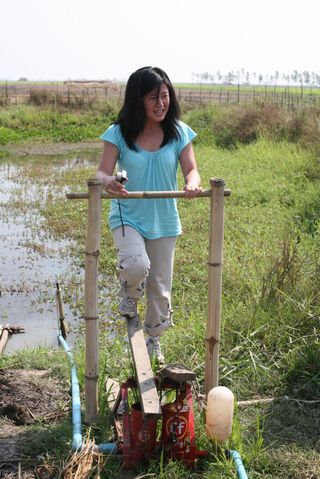
I had actually seen one of their past projects in action in Myanmar while I was there. Here's a picture of me on the water pump that delivered water to the fields. This pump saved the farmer lots of time and since it was cost-efficient and offered several repayment models, the farmers could afford it. I am really excited about these classes because it bridges the gap between theory and practice at universities. I also like the concept that social entrepreneurial classes like these take the already natural curiosity and talent of individuals and channels them to benefit those that have long been ignored.
 The exhibition last week was a showcase of the student projects. Ten projects were displayed and I had a chance to speak to each of the teams and see the prototypes in action. Here are examples of several projects:
* Microfuel: allowed Ethiopian entrepreneurs to transform biomass and agriculture waste into fuel pellets. By switching to fuel pellets, women recapture hours spent carrying firewood.
* Water app: The affordable pressure pump offered poor, dry season farmers the ability to deliver water to their fields. The improved design, with 52 fewer parts and $10 reduction in retail price help farmers increase their annual income by $138.
* Pepper eater: gives women in Ethiopia a more efficient and safer method for crushing dried, red peppers. The pepper eater chops dried peppers into small flakes and separates the seeds. It is designed to cost under $10 and to incorporate local materials and manufacturing techniques.
* ModuloOne: Although 82% of villages are electrified in India, the electrical grid is highly unreliable and many households are unable to capture the spotty electricity for use when they need it most. They cannot afford traditional battery and inverter systems ($110-$400). By finding a way to buy into high-quality energy products in 'bite-sized' pieces, they can have access electricity when needed. The system has a dock with modpods that take in and stores DC power. Other accessories, such as light, cellphone charger and fans can then be attached to the modpod for use.
