APA Community Issues

July 11, 2008

New South Asian American Coaltion

Fern   

From press release dated 6/24/08:

31 South Asian community organizations from 12 regions throughout the United States announced the formation of a National Coalition of South Asian Organizations (NCSO). The newly formed coalition released a detailed action and policy agenda focused on nine key issue areas affecting local South Asian American communities, including immigration, gender equity, and access to services.

Coalition partners include community-based groups that provide social services, organize, and advocate for South Asians in 12 metropolitan areas around the U.S. The groups range from member-led organizations, social service providers, and volunteer collectives that focus on a wide variety of issues such as mental health, domestic violence, racial and religious profiling, and housing and economic development. Their constituents and members include low-wage workers, youth, and LGBTIQ individuals. Some of the groups were established decades ago, while others were formed in the past 5 years.

Continue reading "New South Asian American Coaltion" »

June 17, 2008

The Model Minority

Aag_harry_potter

I was glad to see a New York Times article describe a recent study that challenges the stereotype of Asian-American students as a “model minority” - high achievers that dominate the top echelon of colleges and universities. This study, conducted by New York University, the College Board, and a commission of Asian-American educators, draws attention to the wide spectrum of academic performances levels within the various sub-groups that fall under the broad “Asian-American” label, and points out that the students’ educational success is shaped in part by their family’s socio-economic status. While the study focuses on Asian-American students in college, the issues that it raises appear to apply equally to those in secondary school.

As a Vietnamese-American who immigrated to the U.S. at a young age and attended both public and private schools in urban Oakland, I witnessed how many of my Asian-American peers encountered obstacles to learning similar to those experienced by their African-American or Hispanic classmates. Although numerous reasons contributed to their struggles, the lack of adequate resources was a significant factor.

Continue reading "The Model Minority" »

March 25, 2008

Conversation with Chi-Mei Lin, Executive Director of the Chinese Community Center in Houston

Ccc_2

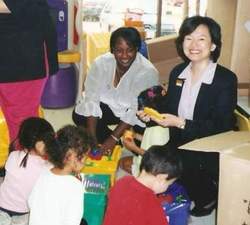
Chi-Mei Lin, serves as executive director of the Chinese Community Center (Center) in Houston, Texas.  The Harvard Business School of Asian Alumni Association (HBS4A) awarded Chi-Mei a scholarship to attend the prestigious Harvard Business School's Strategic Perspectives in Non-Profit Management Program last year.  Thanks to Tom Leung of HBS4A, we were able to connect with Chi-Mei and learn more about her work at the Center.

1. Dien: Chi-Mei, can you share with us a little about your background? How did you get involved with the Chinese Community Center and how long have you been with them?

Chi-Mei: I have 24 years of experience in social service delivery, working with diverse populations. In 1998, the Center approached me about the Deputy Executive Director position. I accepted the position, with the notion of assisting the agency to be proactive in cultivating nonprofit bilingual professionals to work at the agency, and truly advance the Center’s mission to bridge East and West. The Center is the largest Asian-led agency in the southwest region, and yet bilingual Asian professionals are very scarce within the agency, and with other Asian services providers. I later became the Executive Director when the former executive director retired in 2002.

2.  Dien: Can you describe some of your organization’s work and the groups that you serve?

Chi-Mei: The Center's mission is to bridge East and West by enriching families with educational, cultural, and social service programs. In 1979, the Center started as a Weekend Language School that served over 700 families annually in 2007. Over 60% of the students are Asian and 40% are non-Asian.

The Center also has an early childhood center serving over 70 children ages 0-5 and an after-school program that serves over 80 children daily during the school year. During summer, the Center offers day camp and language camp to more than 100 immigrant students. The Center also provides adult ESL and job training programs to new-comers. In 2000, a senior center was added to the core services and the Center now serves over 30 seniors daily with benefits counseling and health education.

3.  Dien: Who supports your organization? Please share with us some of the obstacles you face in your fund development work.

Chi-Mei: The Center maintains a $2.3 million annual budget. We have established a healthy and diverse funding structure: 50% government/public sector, 25% corporate, foundation and private, and 25% tuition and service income. 

Although the Center is a top performing agency in Houston, we work hard to expand funding streams to meet the rising demands for service. It had been challenging to cultivate charitable giving in the Asian community. It is still a somewhat new concept to many first and second generation Asians. However, our successful capital campaign proved that Asian donors give generously to a worthy purpose.

Continue reading "Conversation with Chi-Mei Lin, Executive Director of the Chinese Community Center in Houston" »

March 20, 2008

Higher Education: Endowments Growing at Many US Schools

Jetty

Over the past several months, my alma mater, the University of Virginia, has been sending me invitations to, and reminders about, class reunions that will be held in Charlottesville this summer. Aside from reminding me how much time has passed since graduation, and how much I thoroughly enjoyed those four years, I'm realizing just how focused and organized The University is when it comes to fund raising.

While far from the largest billion-dollar endowment (that honor goes to Harvard), at over $3.6 billion, Virginia is able to operate and has money set aside to provide financial aid to students who otherwise could not afford the tuition. I had read last fall that Yale's Endowment had a banner year in 2007, which comes as no surprise since David F. Swensen, author of "Pioneering Portfolio Management," has been running the endowment since 1988.

What I was surprised to learn recently is that even some of the country's Elite Prep Schools have endowments over $1 billion that help offset the cost of tuition.  And now, even California community colleges are getting in on the act and making substantial strides.

Continue reading "Higher Education: Endowments Growing at Many US Schools" »

March 14, 2008

Desperate Housewives: H-1B + H-4 = Isolation and Depression

358424083_d7c857e4d4

BusinessWeek ran an article last week revealing that India sends the most foreign workers to the US on H-1B visas for high-skilled workers.

Some 45 percent of all H-1B petitions approved in 2005 were for workers from India. What's sometimes lost in all the controversy over the effects on employment (displacement) of American workers, and the US economy generally, is that there are human beings - individuals - behind each visa.

The San Francisco Chronicle ran an article this weekend, detailing the lives of the wives of Indian women in Silicon Valley. The women in the article are the spouses of Indian technology workers in the US on H-1B visas. Although these women are often highly educated, their H-4 visas prohibit them from working in the US. Away from their families, with their husbands work long hours, it's not surprising to learn that these women feel isolated, and often become depressed.

What I found so encouraging was the individual stories of how women formed networks to support one another, and how others made the decision to volunteer in various capacities to sharpen skills and contribute to their communities.

- Don Wong Jr.

Photo courtesy of lovelypetal

February 25, 2008

Asian Americans in Massachusetts Are Diverse

Goldenpond

I received my copy of the 2007 Massachusetts Asian Pacific American Directory last week.  The directory is published by the Institute for Asian American Studies, UMass Boston and the Asian American Resource Workshop.  It is their 9th edition and it lists over 300 Massachusetts Asian or Asian Pacific American organizations, including media outlets. It is an impressive compilation.  Besides their contact information, the authors also provide a short description of each organization.

I was amazed at the number of organizations serving the AAPI (Asian American & Pacific Islander) community in Massachusetts.  I also applaud the two groups for putting the directory together.  The information gathered can help draw attention to the issues in the community and perhaps, increase the necessary funding and support for the organizations trying to address those needs.

Continue reading "Asian Americans in Massachusetts Are Diverse" »

February 08, 2008

How Many Asian Pacific American Nonprofit Groups Are There?

Grandeur

A reader asked if I know the number of Asian Pacific Islander (API) nonprofit groups there are in the US and where he could find such a list.

The answer is - there are lots, but I couldn't direct him to one resource that lists all of them or provide him an exact number.  My best estimate is that we have about 700-800 API organizations of various sizes focused on serving APIs or a specific ethnic group within the API community.  This does not include professional or business associations.  This seems like a small number compared to the 904,313 registered 501(c)(3) charities in the US. However, many API groups are also served by many 'mainstream organizations' within their own city/county.

Here's what I did provide him and if anyone knows of any lists I am missing, please let me know.

~ On Guidestar's website, you can find many API groups but unfortunately, you will have to use keywords unless you know the organization's direct name.  It will be difficult to get a listing of all groups unless you ask them to run a query with the all the relevant keywords and purchase the list from them.

~ The Asian Pacific Islander Nonprofit Economy Report looked at API nonprofit groups in Minnesota.  They found 75 financially active API nonprofit groups.  The oldest one is the Japan American Society of Minnesota that had incorporated in 1972.  The report has a listing of all the groups.

Continue reading "How Many Asian Pacific American Nonprofit Groups Are There?" »

January 31, 2008

Issues in the APA Community - 1/31/08

Water

~ Chinese-American Autism.  Albert Wang, an internist and a partner at Palo Alto Medical Clinic writes that one in 150 children are diagnosed with autism. This is more than the number of children diagnosed with AIDS, juvenile diabetes and cancer combined. In this article, Dr. Wang describes what California needs to do to take care of is growing number of autistic residents. In 1999, he and his wife founded Friends of Children with Special Needs to serve immigrant Chinese-American families with special needs children.

~ Asian Pacific Americans Students Do Not Seek Treatment.  Article from University of California, Irvine about student mental health concerns.  Students have access to counseling but many APAs do not use these services. The author provides several explanations, most of them center around cultural differences. According to Jed Foundation, approximately 1,100 college students take their own lives each year.  See also: My Mother, A Paranoid Schizophrenic: The Stigma of Mental Health Illness and America's Inadequate Mental Health Care System.  Few APAs seek help and when they do, only about one in three receive treatment that meets minimum standards of care.

~ Impact of Gambling on Mental Health.  Article about the signs of gambling addiction.  Asians and Asian Americans have not been shown in any epidemiological study to be linked with more gambling disorders but anecdotal evidence can be seen by the high number of Asian players at card rooms and casinos.  Massachusetts and Las Vegas casinos specifically target Asians for business.  The Mohegan Sun has a 25 person Asian American marketing department.

~ Obesity Rates Among Asian American Youths Growing.  The article describes findings that Asian Americans have the fastest growing rate of overweight and obese children despite stereotypes that Asians are petite and skinny. Cultural and environmental factors contribute to the cause.  Asian teens consume more fast food than their white counterparts. They are least likely to get their daily portions of fruits and vegetables. They are also least physically active of all racial and ethnic groups. Eating white rice as the main dish in meals and lack of fresh food choices for those living in low-income neighborhoods are also factors.

January 19, 2008

Asian Pacific American Nonprofit News - January

~ Where We Are Now: Activism Today.  Kearny Street Workshop will be presenting a panel on the topic on January 22 in San Francisco.  It is the second in a series of discussions that is part of KSW's Activist Imagination program exploring the past, present, and future of arts and activism.  The panel features San Francisco School Board member Eric Mar, National Network for Immigrant and Refugee Program Director Diana Pei Wu, artist-activist and founding member of Eastside Arts Alliance Favianna Rodriguez, and activist and co-founder of Liberation Ink Le Tim Ly.  The panel is moderated by community activist, Robynn Takayama.

~ Growing Opportunities: Will Funding Follow the Rise in Foundation Assets and Growth of AAPI Populations?  Peggy Saika of AAPIP and Joe Lucero, Research Consultant will present the data and findings from the recent survey about disparate giving to the AAPI community.  Stacie Ma'a of The Wallace Alexander Gerbode Foundation and Vincent Pan, Executive Director of Chinese for Affirmative Action are also panelists.  The event will be held on Feb 12 in San Francisco.  You can register here.  I had previously wrote about the findings of the report in this post: Key Gaps in Funding AAPI Community.

Continue reading "Asian Pacific American Nonprofit News - January" »

January 03, 2008

Asian American Nonprofit News - December

Pinkflowers

Report Analyzes Effects of the World Trade Center Attack on Chinatown
The nonprofit organization, Asian American Federation of New York, has issued a report detailing the unemployment rates, business closings, and lost revenues in Chinatown after the Sept. 11th attack.  The estimated lost wages totaled $114 million.  In the garment manufacturing business, Chinatown's largest industry, 40 out of 246 factories have closed.

Committee of 100 Release Survey: Hope & Fear: American and Chinese Attitudes Towards Each Other
The survey found that Chinese and Americans generally hold favorable views toward each other but a strong majority of Americans view China's emerging economic and military power as a threat to the US.  The survey covers a broad range of bilaterial issues, including economics and trade, environment, mood of the country and foreign policy.  The Committee of 100 is a national non-partisan, non-profit orgranization consisting of Chinese-American leaders.

Asian Women United of Minnesota (AWUM)
Despite a troubled history, AWUM will continue to provide API women and children safety and protection from family violence.  The organization now has new board leadership and management.  It served over 50 families last year and has the capacity to house up to 24 families at a time for 30 days. 

Marilyn Tam Receives International Femtor 2007 Lifetime Achievement Award
Audrey Magazine featured Marilyn Tam in its Oct/Nov edition for receiving the Award from eWomenNetwork.  A Femtor is a "wise and trusted woman providing knowledge, inspiration and practical information to other women." 

Marily previously served as Vice President of Apparel and Accesories for Nike, Inc., and President of the Reebok Apparel and Retail Groups.  She is also the co-founder of three other corporations.  She is also the author of the self-help book, How to Use What You've Got to Get What You Want.

Marilyn also co-founded Us Foundation to promote solutions to social, economic and environmental issues.  Projects of the Foundation inlude relief efforts and humanitarian missions to aid health-care and welfare in poor areas of Bangalore, India and Tibet.

About the photo: This was taken inside the Bellagio Hotel, Las Vegas.
